
Demand for logistics space increases while investment volumes fall by 60%
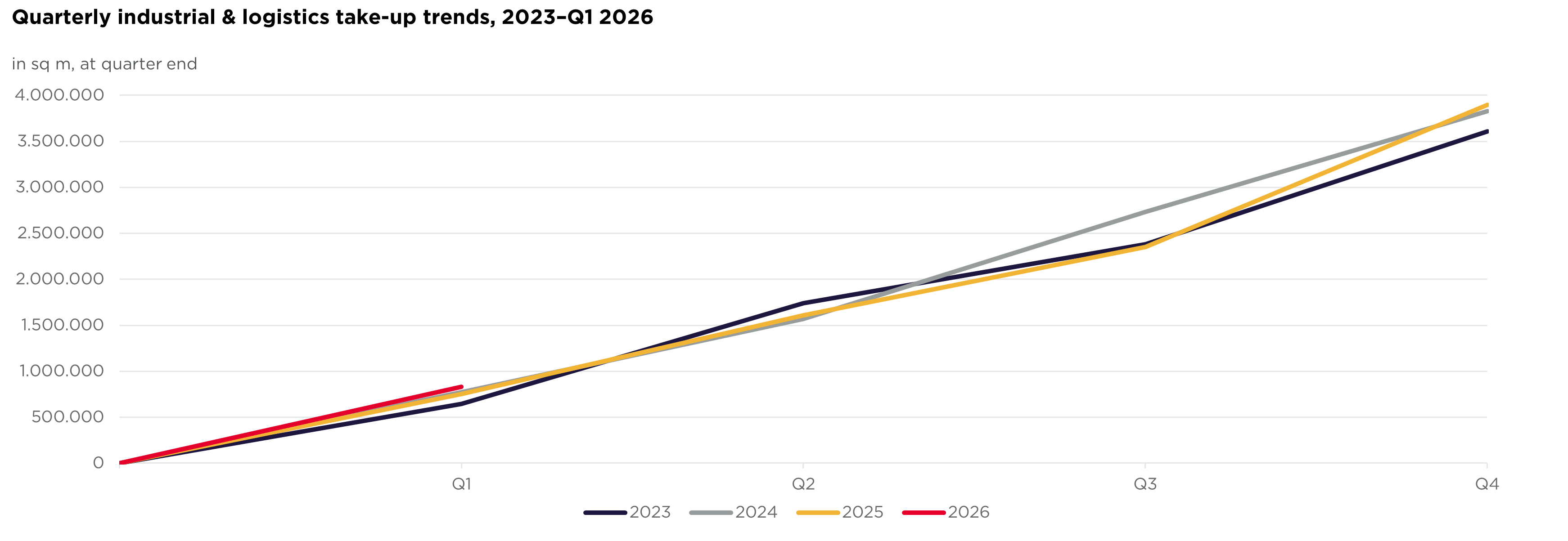
Demand for logistics and industrial space in the Netherlands increased in the first quarter of 2026, while investment volumes in logistics real estate declined sharply. According to the latest figures from Cushman & Wakefield, take‑up volume rose by 10.5% year‑on‑year in Q1 to approximately 833,000 sq m, while total investment volume in the sector amounted to around €265 million, representing a 60% decrease compared with the same period last year.
This contrast highlights the current dynamics of the market: operational fundamentals remain strong, while investors and developers are increasingly constrained by structural bottlenecks.
 |
|
|
Quarterly industrial & logistics take‑up trends, 2023–Q1 2026 Bron: Cushman & Wakefield |
Market recovery continues, but selectivity increases
Across the broader Dutch real estate market, the first quarter showed signs of recovery. Total investment volume reached €3.1 billion, an increase of 48% year‑on‑year.
In the logistics sector, however, only a limited number of transactions were completed. Investors focused primarily on high‑quality assets in prime locations such as Rotterdam, Venlo, Tilburg and Schiphol, where infrastructure, labour availability and accessibility converge, alongside strong tenant profiles, long lease terms and future‑proof specifications.
While investors remain active, they are highly selective in a market that has become more sensitive to interest rates, costs and uncertainty.
On the occupier side, the market continues to demonstrate resilience. Large transactions exceeding 50,000 sq m were largely absent, yet demand for high‑quality, future‑proof logistics space remains robust. Occupiers are increasingly prioritising sustainability, energy security and strategic location.
Due to the limited supply of modern logistics space, prime rents continue to rise, while pressure on outdated stock is increasing. This is further widening the divide between future‑proof distribution centres and obsolete logistics assets.
“Demand for logistics space in the Netherlands remains strong, but structural constraints are having a dampening effect on the market,” says Sander van Tuijl, Head of Leasing at Cushman & Wakefield Netherlands. “If the Netherlands is to maintain its competitive position as a logistics hub, faster permitting processes, sufficient energy capacity and an attractive investment climate are essential.”
Sander van Tuijl, Head of Leasing Cushman & Wakefield Netherlands: “Demand for logistics space in the Netherlands remains strong, but structural constraints are having a dampening effect on the market. If the Netherlands is to maintain its competitive position as a logistics hub, faster permitting processes, sufficient energy capacity and an attractive investment climate are essential.”
Structural bottlenecks continue to weigh on investment
Grid congestion is hampering both new development and the sustainability upgrade of existing distribution centres. At the same time, rising construction costs, higher land prices and increasing financing costs are putting additional pressure on the feasibility of new projects. Meanwhile, competing logistics regions in Germany, Belgium and Eastern Europe are actively investing in infrastructure and business climate improvements. This increases the urgency for the Netherlands to continue facilitating modern logistics development.
Fiscal policy also plays a significant role. The real estate transfer tax for commercial property in the Netherlands stands at 10.4%, which Cushman & Wakefield identifies as a barrier to transactions and international investment appetite. In a market where investors are increasingly focused on risk, returns and future resilience, predictable policy, adequate energy capacity and efficient permitting procedures are critical to safeguarding the Netherlands’ competitive position in the logistics sector.
