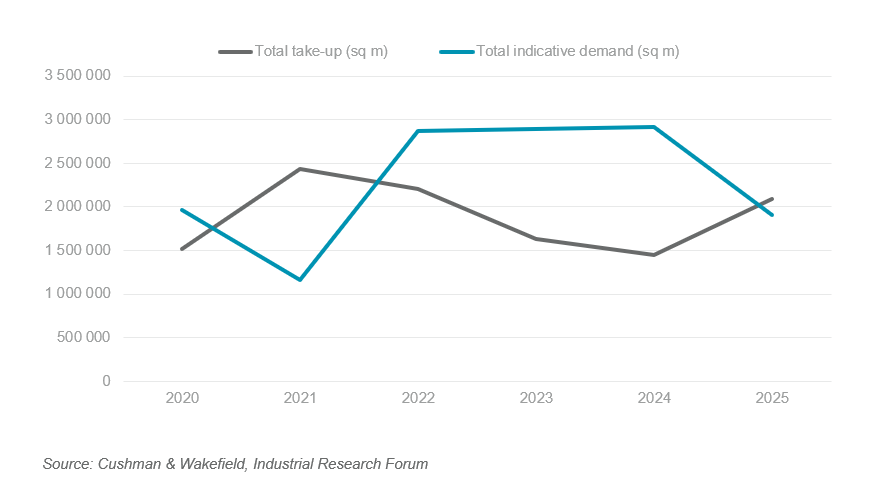
In 2025, indicative demand for industrial and logistics space in the Czech Republic almost matched the volume of lease agreements actually signed for the first time in several years. This follows data and long-term market monitoring by real estate consultancy firm Cushman & Wakefield.
The year 2025 marked a turning point for the Czech industrial and logistics real estate market. Indicative demand reached approximately 2.2 million square metres and the volume of finally signed lease agreements about 2.1 million square metres, meaning that after several years the two indicators moved significantly closer again. In 2020–2024, there had been a persistent and substantial gap between expressed interest in leasing (indicative demand) and contracts actually concluded (gross take-up).
Between 2021 and 2023, indicative demand rose from roughly 1.16 million square metres to 2.9 million square metres (around 2.5 times), while signed leases lagged behind expectations. The difference reflected companies’ caution, limited availability of suitable space, and longer approval and investment cycles amid heightened geopolitical and economic uncertainty.
The year 2024 brought a correction on both sides: indicative demand fell below 2.0 million square metres and realised leasing to about 1.45 million square metres. In 2025, the market accelerated again: indicative demand increased by roughly a tenth year-on-year (to approx. 2.2 million sq m) and the volume of signed contracts grew by about 45% year-on-year (to 2.1 million sq m). After years of divergence, the curves of both indicators intersected again.
Jiří Kristek, Partner, Head of Occupier Services: “2025 showed that companies stopped relying solely on ‘cautious scenarios’ and began closing projects prepared in previous years. The numbers make it clear: the difference between indicative demand and realised leases has practically disappeared after a long time.”
The convergence of indicative demand and the volume of signed lease agreements in 2025 can be interpreted as a sign that companies have adapted to new conditions. After a period of waiting and reassessing strategies, businesses began adjusting to prolonged elevated uncertainty linked to geopolitical risks, changes in supply chains and higher financing costs.
Chart 1: Total gross take-up vs. previous year’s indicative demand1
Jiří Kristek, Partner, Head of Occupier Services: “In practice, this means tenants should start addressing new premises earlier, as high-quality units in good locations are disappearing faster and the decision window is shortening. It pays to have alternatives ready in terms of location and size, and also to consider that companies today are more often seeking capacity for higher inventory levels and more stable operations. For developers, the importance of project flexibility and pre-leasing is growing.”
Part of the demand is also linked to the reshuffling of manufacturing and logistics activities within Europe. In this context, the Czech Republic remains attractive thanks to its location, infrastructure and industrial tradition, which is reflected in continued interest in industrial space.
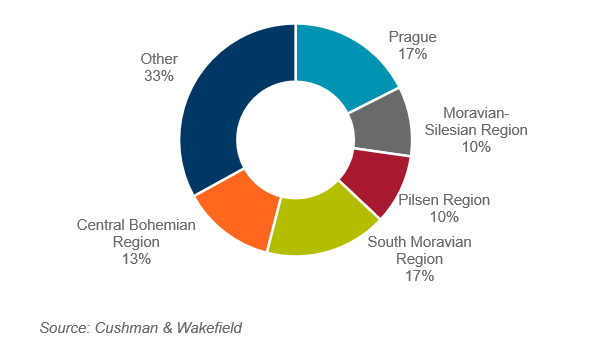
From a regional perspective, indicative demand has long been concentrated in several key areas. The most significant volumes of interest are seen in Prague and its surroundings, followed by the South Moravian Region, the Pilsen Region, and selected parts of the Moravian-Silesian and Central Bohemian regions. These regions were also the key drivers in 2025, when the increased level of signed lease agreements was concentrated primarily in established locations with accessible infrastructure and ready-to-go projects. In some regions, demand was also supported by attractive pricing or incentives offered.
Chart 2: Indicative demand by region in 2019
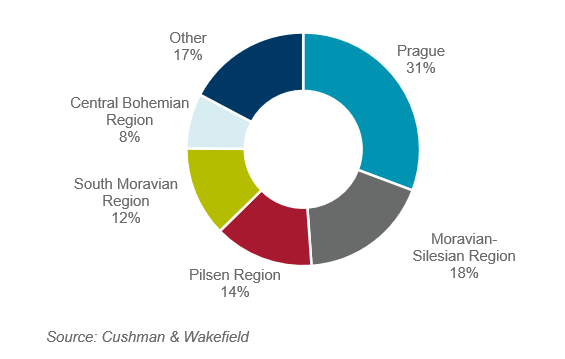
Chart 3: Indicative demand by region in 2025
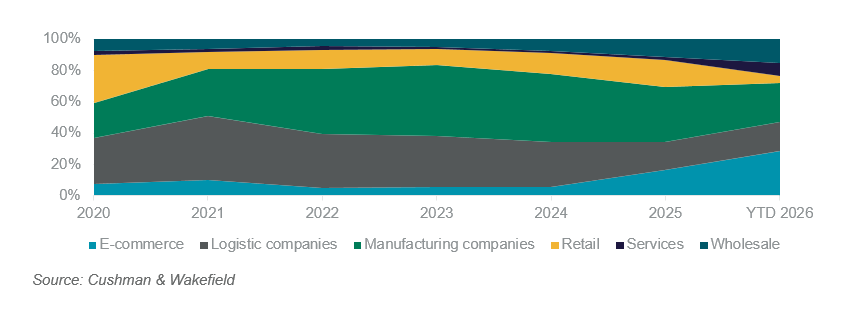
The largest share of indicative demand has long been generated by logistics and manufacturing companies, which together account for most of the space demanded. E-commerce also plays an important role, with demand volumes increasing significantly in recent years compared to the period before 2020.
Chart 4: Indicative demand by tenant sector
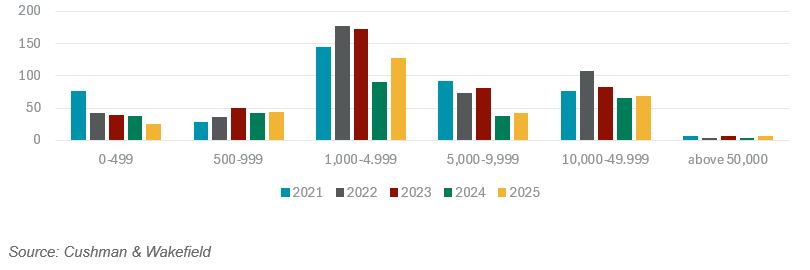
In terms of the size of space demanded, medium-sized units dominate, especially in the 1,000–5,000 sq m and 10,000–50,000 sq m ranges. These categories have long represented the largest part of the market in terms of the number of transactions. The average size of a single indicative demand has increased over time, suggesting that companies are planning larger and more complex operations, often with a higher level of automation.
Available data for the first three months of this year confirm that indicative demand for industrial space remains active across regions and sectors. The demand structure is not changing: established locations, logistics and manufacturing companies, and medium-sized units continue to dominate. Detailed statistics on finally signed lease agreements for Q1 2026 are not yet available; indicative demand therefore currently serves as the main leading indicator of further market development.
Jiří Kristek, Partner, Head of Occupier Services: “For the next period, it will be crucial whether the activity seen in 2025 translates into more new construction and faster turnover of supply. At the same time, we are monitoring global factors that may continue to increase logistics costs and add complexity—from rising fuel prices and local disruptions to higher cargo insurance costs. This may secondarily feed into goods prices and inflation, and in real estate into a more cautious pace of new supply. Companies are therefore strengthening supply-chain resilience and shifting from ‘just-in-time’ to ‘just-in-case’ models with higher inventory levels, supplier diversification, and greater use of digital tools to improve visibility of goods flows. In Q1 2026, we are seeing consistently high interest across regions and sectors, so indicative demand remains an important leading indicator for the rest of the year.”
Chart 5: Breakdown of indicative demand by size of space required